
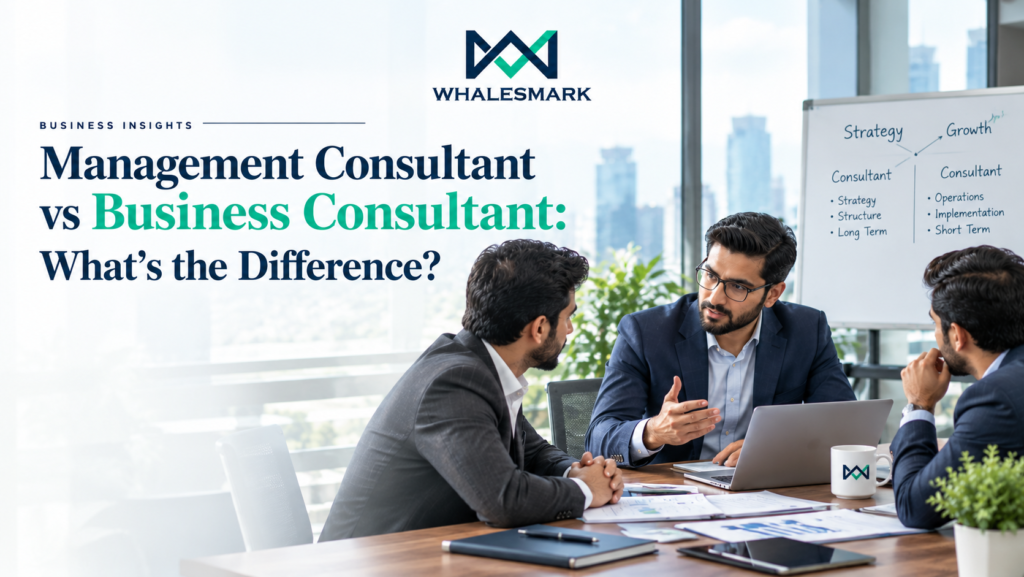
Choosing the right consultant can become surprisingly difficult when different firms use similar terminology. A company may need help with growth, operations, restructuring, market expansion, finance, or technology, yet the consultant’s title does not always reveal what they actually deliver.
The management consultant vs business consultant distinction becomes useful when you focus on the business problem rather than the job title. Both can help organisations improve performance, but their scope, starting point, and typical engagement can differ.
Current consulting research also shows that Pakistan’s consulting market covers areas including strategy, operations, financial advisory, risk management, and digital transformation.
Table of Contents
Management Consultant vs Business Consultant: The Core Difference
The simplest way to understand management consultant vs business consultant is to look at the problem being solved.
A management consultant generally takes a broader organisational view. The work can involve strategy, operations, organisational structure, performance, technology, risk, or transformation.
A business consultant can focus more specifically on a business challenge such as growth, market positioning, profitability, sales, expansion, or a particular commercial decision.
The distinction is not absolute. Consulting firms often use these terms differently, and their services can overlap. Current professional guidance similarly describes business and management consulting as overlapping fields rather than completely separate professions.
That overlap is an important part of the consultant difference.
What Does a Management Consultant Do?
A management consultant looks at how an organisation works as a whole.
Suppose a growing company has rising sales but declining margins. The problem might involve pricing, procurement, staffing, inventory, financial controls, or inefficient processes.
A management consultant can investigate these connected issues instead of treating the margin problem in isolation.
This is where the management consultant vs business consultant question becomes practical. Management consulting can extend across several functions when the underlying problem crosses departmental boundaries.
Typical assignments may include:
- organisational restructuring
- operational improvement
- performance management
- transformation programmes
- risk and resilience
- strategic planning
- technology-enabled change
The exact scope depends on the firm’s expertise and the client’s requirements.

What Does a Business Consultant Do?
A business consultant can work on a more defined commercial challenge.
For example, a company might want to enter Lahore, launch a new product, improve profitability, develop a franchise model, or assess whether a new customer segment is commercially attractive.
The consultant may analyse the market, competitors, customers, financial requirements, and internal capabilities before recommending a direction.
This creates another useful consultant difference: the assignment is often framed around a specific business objective.
However, business consulting can also become broad when the recommended solution requires changes across finance, operations, people, or technology.
Where Does a Strategy Consultant Fit?
A strategy consultant typically concentrates on major decisions about direction and competitive positioning.
Should the company enter a new market?
Which customer segment should it prioritise?
Should it diversify?
Where should future investment go?
These questions require analysis of market conditions, competitors, economics, capabilities, and risks.
Indeed describes strategy consulting as a form of management consulting focused on specific strategic challenges.
This means a strategy consultant can operate within the wider management consulting landscape rather than representing an entirely separate profession.
In practical terms, a strategy consultant often helps answer, “Where should we compete and why?”
Management Consultant vs Business Consultant for Growing Companies
For a growing Pakistani business, management consultant vs business consultant should not be treated as a simple either-or decision.
Consider a manufacturing company planning expansion.
If the main question is whether demand exists in a new region, a business consultant or strategy consultant may focus on market research, competition, pricing, investment requirements, and commercial potential.
But if the company already knows it wants to expand and cannot determine whether its supply chain, reporting systems, staffing, finance, and operational processes can support that expansion, broader management consulting may be more relevant.
That is the practical consultant difference.
The first assignment centres on the commercial opportunity. The second examines organisational readiness.

When a Strategy Consultant Makes Sense
A strategy consultant can be particularly relevant when senior management faces a high-impact decision with several possible directions.
The work may involve market-entry analysis, growth strategy, competitive positioning, portfolio decisions, pricing strategy, or long-term investment planning.
The value comes from structuring a complex decision.
A strategy consultant does not replace management’s authority. Instead, the consultant provides analysis, frameworks, evidence, and scenarios that can help decision-makers evaluate alternatives.
This approach is increasingly relevant as Pakistani companies deal with digital transformation, changing customer expectations, regulatory requirements, and competitive pressure. Recent market research identifies strategy consulting and digital transformation among important areas of Pakistan’s consulting market.
When Broader Management Consulting Is More Suitable
A company may need broader support when the problem cannot be separated from the way the organisation operates.
For example, implementing AI may appear to be a technology project, but successful adoption can require workflow redesign, governance, employee training, data improvements, and leadership involvement.
McKinsey’s global AI research found that organisations are redesigning workflows and establishing governance as they work toward generating value from generative AI.
That illustrates an important consultant difference. Technology advice alone may not solve an organisational transformation problem.
A strategy consultant may help determine why and where the company should invest in AI, while management consulting can extend into how the organisation changes its processes and capabilities.
How to Choose the Right Consulting Partner
Instead of asking only about titles, businesses should ask four practical questions.
What Problem Are We Solving?
Define the decision or performance issue before selecting a consultant.
How Broad Is the Problem?
If several departments are involved, broader management expertise may be necessary.
Do We Need Direction or Execution?
A strategy consultant may be appropriate when the main requirement is strategic direction. Broader consulting may be more suitable when implementation and organisational change are also required.
What Expertise Does the Firm Actually Have?
The real consultant difference often appears in the firm’s capabilities, methodology, industry experience, and ability to connect recommendations with implementation.
Why Whalesmark Can Support Both Needs
For businesses evaluating the management consultant vs business consultant question, Whalesmark Consulting brings together Business Strategy & Growth Consulting, Financial Planning & Performance, Corporate Structuring & Compliance, Risk Management & Business Resilience, Data Intelligence & Decision Analytics, Digital Transformation & Innovation, Supply Chain & Operational Excellence, and Franchise Development & Market Expansion.
This broader capability matters when a commercial decision affects multiple parts of an organisation.
A strategy consultant may identify an attractive expansion opportunity, but the business may then need financial planning, operational design, risk assessment, or digital transformation support to execute it.
That is where the consultant difference becomes less about titles and more about the depth of support available.
The Commercial Takeaway
The management consultant vs business consultant debate becomes much clearer when businesses stop comparing labels and start comparing problems.
A business consultant may be engaged around a specific commercial objective. A management consultant may address broader organisational performance. A strategy consultant often focuses on high-impact choices about direction and competitive positioning.
In practice, the boundaries overlap.
The most useful consultant difference is therefore not the name printed on a proposal. It is whether the consultant understands the problem, has the required expertise, can support the relevant decisions, and can translate recommendations into practical action.
For businesses considering consulting support, that is the comparison that matters most.
FAQs
What is the difference between a management consultant and a business consultant?
The management consultant vs business consultant distinction usually relates to scope. Management consulting often addresses broader organisational performance, while business consulting may focus on specific commercial challenges. However, the services can overlap.
Is a strategy consultant the same as a management consultant?
A strategy consultant commonly focuses on strategic decisions such as growth, market entry, positioning, and investment. Strategy consulting is often considered a specialised area within the broader management consulting field.
How do I identify the right consultant for my company?
Start with the business problem rather than the title. Consider whether you need strategic direction, commercial analysis, operational improvement, transformation support, or a combination. This helps clarify the consultant difference relevant to your situation.
Why should Pakistani businesses consider management consulting?
Businesses may seek consulting support when they face complex growth decisions, operational challenges, digital transformation, restructuring, market expansion, or performance issues requiring specialised external analysis. Pakistan’s consulting market includes strategy, operations, financial advisory, and digital transformation services.