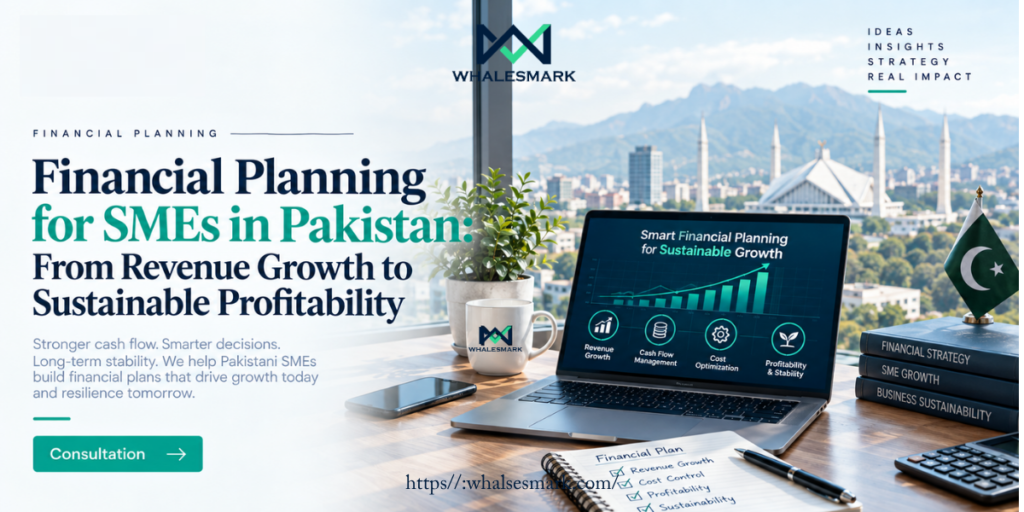
Revenue growth looks impressive on paper. A business that increases monthly sales from PKR 5 million to PKR 8 million appears to be moving in the right direction.
But what if operating costs rise even faster?
What if customers take longer to pay?
What if inventory absorbs the additional cash?
What if the business generates more sales but ends the year with almost the same profit?
These situations explain why financial planning for SMEs Pakistan needs to go beyond revenue targets.
For Pakistani SMEs, financial planning connects sales growth with margins, working capital, cash flow, financing, taxation, investment and profitability. The objective is not simply to sell more. It is to understand whether growth actually creates financial value.
This issue has become particularly relevant as Pakistan strengthens its SME financing framework. The State Bank of Pakistan revised SME financing regulations for 2026 and, in July 2026, revised the regulatory sales-turnover thresholds for micro, small and medium enterprises.
Table of Contents
Why Revenue Growth Does Not Automatically Create Profit
Many SME owners naturally focus on sales because revenue provides a visible measure of business activity.
However, revenue tells only part of the story.
Imagine a distributor increases annual sales by 30%. To achieve that growth, the company offers larger discounts, increases credit periods, hires additional staff and carries more inventory.
Sales rise.
But gross margin falls, receivables increase and operating costs consume the additional revenue.
The company has grown, but its financial position may not have improved proportionately.
A proper profitability strategy prevents this situation by connecting revenue targets with gross margin, operating expenses, working capital and net profit.
What Financial Planning for SMEs Pakistan Should Cover
Effective financial planning for SMEs Pakistan should bring several financial decisions into one framework.
Revenue Forecasting
Start with realistic sales assumptions.
Break revenue down by product, customer segment, location, sales channel or business unit. Instead of assuming that sales will simply grow by 20%, identify exactly where that growth should come from.
Cost Planning
Separate fixed and variable costs.
Rent, core salaries and certain software expenses may remain relatively stable. Raw materials, logistics, commissions and transaction costs may increase with sales.
Understanding this distinction helps management estimate how additional revenue will affect profit.
Cash Flow Planning
Profit and cash are not the same.
A company can report a profit while struggling to pay suppliers because customers have not yet settled their invoices.
That makes cash-flow forecasting one of the most important elements of SME finance Pakistan.

The Working Capital Problem Behind Fast Growth
Working capital often becomes a hidden constraint when SMEs expand.
Suppose a company wins a major customer. It now needs more inventory, production capacity and staff. However, the customer may pay after 60 or 90 days.
The SME must finance that gap.
This creates a cycle:
More sales → more receivables → more working capital required.
If management ignores that cycle, growth can create a cash shortage.
This is why financial planning for SMEs Pakistan should include working-capital assumptions alongside revenue forecasts.
SME Finance Pakistan Is Becoming More Important
Access to financing remains a significant issue for Pakistani SMEs.
The Ministry of Industries and Production highlighted limited access to credit as one of the longstanding challenges affecting SMEs while reviewing a comprehensive SME business plan in December 2025.
In January 2026, the ministry also reported discussions around expanding SME lending, financial inclusion and supply-chain finance.
This makes financial preparation increasingly important.
Banks and financing institutions need evidence that a business understands its financial position.
An SME with organised financial statements, cash-flow forecasts, realistic assumptions and documented repayment capacity can approach financing discussions with much stronger information than a business that relies only on historical sales figures.
Build a Profitability Strategy Around Margins
Revenue growth can hide weak margins.
A business may sell a product for PKR 10,000 while spending PKR 8,500 to deliver it. Another product may generate PKR 7,000 in sales but produce PKR 2,500 in contribution.
Without product-level analysis, management may focus on the product with higher revenue rather than the one that creates more contribution.
A practical profitability strategy should therefore examine:
- gross margin by product or service
- customer profitability
- contribution margin
- direct and indirect costs
- discounting
- delivery and fulfilment costs
- employee productivity
- overhead allocation
This analysis can reveal where the business actually makes money.

Use Scenario Planning Instead of One Forecast
No financial forecast remains perfectly accurate.
Exchange rates can change.
Input costs can rise.
Customer demand can weaken.
Interest rates can affect financing costs.
Tax rules can change.
Instead of preparing one financial forecast, SMEs can build several scenarios.
Base Case
The business achieves its expected sales and cost assumptions.
Downside Case
Sales fall, collection periods increase or costs rise.
Growth Case
Demand exceeds expectations and the business needs additional inventory, employees or financing.
This approach makes financial planning for SMEs Pakistan more useful because management can prepare responses before circumstances change.
Financial Consulting Pakistan Can Help Connect the Numbers
Many SME owners understand their businesses extremely well but do not have the time to build detailed financial models.
This is where financial consulting Pakistan can provide practical value.
A financial consultant can help management organise financial information, develop budgets, analyse profitability, forecast cash flow and evaluate investment or financing decisions.
The goal should not be to produce complicated spreadsheets that nobody uses.
The goal should be to create financial information that management can use to make better decisions.
Tax Planning Should Be Part of the Financial Model
Tax should not appear only at the end of the financial year.
It can affect pricing, investment decisions, cash flow and business structure.
SMEs should understand their applicable tax obligations and incorporate expected tax payments into cash-flow planning.
For companies considering expansion, financial consulting Pakistan can also help management assess how different investment and business decisions may affect overall financial performance.
Tax decisions, however, should always reflect the company’s specific circumstances and applicable Pakistani tax rules.
Financial Planning Should Connect to Business Strategy
A financial plan should never operate separately from the company’s strategy.
If the business wants to enter a new city, the financial plan should estimate the investment and expected return.
If management wants to launch a new product, the model should include development, marketing, inventory and distribution costs.
If the company wants to expand internationally, the plan should consider foreign-currency exposure, logistics, working capital and financing.
This is where profitability strategy becomes a management tool rather than merely an accounting exercise.
Prepare Better Information for SME Financing
A business seeking external financing should know its numbers before approaching a lender.
At minimum, management should understand:
Revenue
What drives sales, and how sustainable are those drivers?
Profitability
Which products, customers or services generate the strongest margins?
Cash Flow
How much cash does the business generate after operating requirements?
Debt Capacity
How much additional financing can the business realistically service?
Working Capital
How much funding does the business require to support its operating cycle?
These questions form the foundation of stronger SME finance Pakistan planning.
The State Bank’s revised SME framework also changed regulatory turnover categories, with micro enterprises defined as having annual sales up to PKR 30 million, small enterprises above PKR 30 million to PKR 400 million, and medium enterprises above PKR 400 million to PKR 2 billion.
That makes accurate financial records even more useful when businesses assess their position within the formal financing ecosystem.
Build a Monthly Financial Dashboard
Annual accounts arrive too late to manage many business problems.
SMEs can benefit from a simple monthly dashboard showing:
- revenue
- gross margin
- operating expenses
- EBITDA or operating profit
- receivables
- payables
- inventory
- cash balance
- debt obligations
- cash conversion cycle
Management can then compare actual performance against budget.
If revenue remains on target but margins fall, management can investigate pricing or input costs.
If profit rises but cash declines, management can examine receivables and inventory.
This turns financial planning for SMEs Pakistan into an ongoing management process.
Where Whalesmark Can Support SME Financial Planning
Whalesmark Consulting provides financial planning and performance services alongside business strategy, tax advisory, risk management, data intelligence and other business advisory capabilities.
That combination can help SMEs connect financial information with wider business decisions.
For example, a profitability review may reveal that a company needs better pricing rather than simply more sales.
A cash-flow review may reveal that the business needs stronger receivables management rather than additional debt.
A performance dashboard may reveal that one business segment produces significantly stronger returns than another.
This is where financial consulting Pakistan can move beyond bookkeeping and support management decision-making.
From Growth Targets to Financial Discipline
Pakistan’s SME ecosystem continues to receive attention from policymakers, financial institutions and business-development organisations. The Ministry of Industries and Production has also been working on SME financing and broader business-support initiatives, while SMEDA remains the government’s dedicated SME development institution.
For individual businesses, however, financial discipline still starts internally.
An SME needs to know where its revenue comes from, where its costs go, how quickly it converts sales into cash, which customers create value and how much capital it needs to grow.
A strong profitability strategy brings those questions together.
The result is a business that can pursue growth without losing sight of cash, margins and financial resilience.
Final Thoughts
The objective of financial planning for SMEs Pakistan should not be to predict every future number perfectly.
It should help management make better decisions under changing conditions.
Revenue growth matters.
But profitable revenue matters more.
Profit matters.
But profitable growth that also generates healthy cash flow provides a stronger foundation.
And financing can accelerate expansion, but only when the business understands how much capital it actually needs and how it will repay it.
For Pakistani SMEs, the move from revenue growth to sustainable profitability requires a connected financial approach involving forecasting, working capital, cost control, financing, taxation and performance measurement.
That is where SME finance Pakistan, a disciplined profitability strategy, and appropriate financial consulting Pakistan can work together.
Growth should be the beginning of the financial conversation, not the end.
FAQs
What does financial planning for SMEs Pakistan include?
Financial planning for SMEs Pakistan typically includes revenue forecasting, budgeting, cash-flow planning, working-capital management, profitability analysis, financing requirements and financial performance monitoring.
Why is SME finance Pakistan important for growing businesses?
SME finance Pakistan can provide businesses with capital for working capital, equipment, expansion and other investments. However, SMEs should first assess repayment capacity and the financial impact of additional borrowing.
How can an SME improve its profitability strategy?
A profitability strategy can include product-level margin analysis, better pricing, cost control, customer profitability analysis, working-capital improvements and regular comparison of actual results against budgets.
When should an SME consider financial consulting Pakistan?
An SME may consider financial consulting Pakistan when management needs support with financial modelling, cash-flow forecasting, profitability analysis, budgeting, financing decisions or linking financial performance with broader business strategy.