
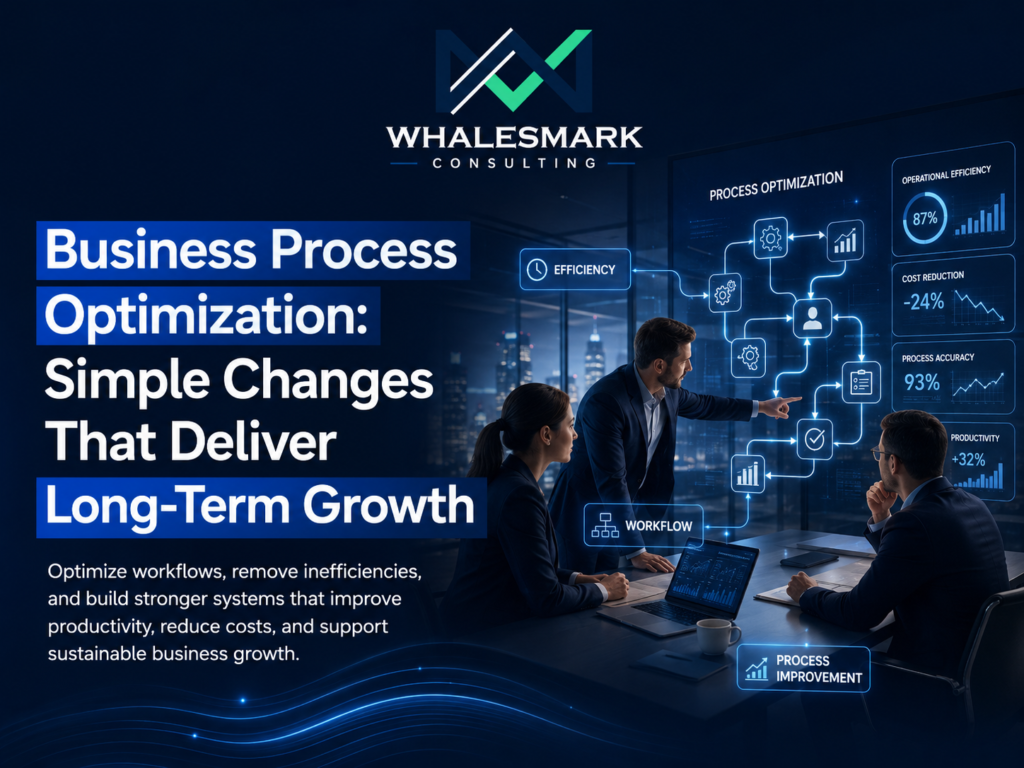
A successful business relies on good processes. Every activity in a business has a process.All business processes are some kind of process, from answering customer questions to sales, operations, finances, delivery and reporting. The processes are transparent and streamlined, allowing the business to function smoothly. If they are slow, confused or outdated, growth is hard.
Business Process Optimization is the process of optimizing business processes. It can cut down waste, save time, quality up performance, and get better results for companies. The good news is optimization doesn’t necessarily involve significant investment and restructuring. Sometimes if you make some simple changes, you can have long-term growth.
Table of Contents
What Is Business Process Optimization?
Business process optimization is about looking for work processes and improving them. It concentrates on identifying delays, redundant tasks, unnecessary steps, communication barriers and more that hinder performance.
The aim is not just to speed up work but to also improve it. The true objective is to work more efficiently.
A business process can comprise of:
- The manner in which the customers place their orders.
- How to make an invoice.Creating of invoices.
- How tasks are reported in the workplace.
- How teams communicate
- The way approvals are being dealt with.The process of approving things.
- The way complaints are handled and resolved by the customer.
Improved processes lead to a more productive and manageable business.

Why Business Process Optimization Matters
Time and money is lost by many businesses without awareness. Workers can be engaged in repetitive manual tasks for hours. Managers may waste time following up on simple tasks. Customers might be waiting for answers for too long. Reports might be late if data is not properly formulated.
Process improvement helps companies:
- Reduce operational delays
- Improve employee productivity
- Lower unnecessary costs
- Improve customer experience
- Make better use of technology
- Minimize error and misinterpretation
- Support long-term growth
This is particularly significant with growth businesses. If the internal systems are weak, then a company cannot scale properly. Whalesmark frequently emphasizes the real world of business improvement, and business process optimization is a very practical approach to creating a more solid internal company.
Identify What Is Slowing the Business Down
Knowing where problems are in a business process is the first step toward business process optimization. A lot of companies attempt to solve the symptom instead of the root cause.
A firm might feel that its sales force isn’t performing up to expectations, for instance. After reviewing the process, however, the actual issue could be that leads aren’t being tracked, that they’re not being followed up on, that their information isn’t complete or that there isn’t adequate communication between marketing and sales.
The following are typical symptoms of weak processes:
- Tasks are performed in a longer time than they should be.
- Staff do repetitive tasks
- Customers are complaining about delays
- Problems managers encounter are always the same.
- Important information is hard to find
- There is excessive manual effort by teams.
- Deadlines are missed frequently
With the above problems clarified, the company can begin to work on its enhancements incrementally.
Remove Unnecessary Steps
Business processes get complicated with time. As businesses expand, more steps, approvals, forms, checks are added on. Some of these could be helpful, others could just be getting in the way.
One easy way to improve operational efficiencies is to ask:
- Do you need to take this step?
- Does it add value?
- Can it be removed?
- Is it possible to pair it with another step?
- Is there any way to automate it?
For instance, if a customer request requires three different people’s approval before it will be acted upon, the company should inquire if all three of those approvals are necessary. Every steps you remove that are not necessary can save you time and help improve the customer experience.
Improve Communication Between Teams
One of the major contributors to a process’s failure is poor communication. If departments don’t share information well, errors occur. Sales can promise something that’s not possible in operations. Finance may await documents from other team. Customer service might not be aware of the most up-to-date information of an order.
Process improvement can be achieved at little or no extra expense through better communication.
Businesses can enhance their communication by:
- Establishing effective communication links
- Joyfully working together in the same project management system.
- Conducting brief and focused meetings
- Assignments of responsibility for each task
- Having the needed information all in one place
- Minimising back and forth correspondence
If everyone is aware of who to reach out to, what to do, and where to obtain information, then the work goes smoother and quicker.

Use Technology Where It Adds Real Value
Technology can speed up processes, but it can only do so if it’s used correctly. Many companies spend money on digital without knowing what they need. This may only cause more confusion rather than help to alleviate it.
Technology can assist in the following:
- Customer relationship management
- Sales tracking
- Accounting and invoicing
- Inventory management
- Employee task management
- Marketing automation
- Data reporting
- Customer support
A CRM system, for instance, can assist when a business misses out on customers leads when follow ups are not arranged, etc. When it takes a long time to prepare reports by hand, dashboard tools can make it easier to keep track of the data.
The right technology enables business process optimization that makes work easier, faster and more organized.
Standardize Repeated Tasks
All businesses have routine workflows that are performed over and over. Errors and delays increase if they are performed differently every time. Standardization contributes to consistency.
Businesses can standardize:
- Customer onboarding
- Order processing
- Complaint handling
- Employee training
- Reporting formats
- Quality checks
- Sales follow-ups
Standard operating procedures are particularly beneficial for expanding businesses. They help with the easier training of new employees, quality maintenance and ease the dependency on one person.
As the tasks become more uniform, the company is more stable and can be sustainable for a longer period.
Focus on Customer Experience
Business process optimization always needs to be executed in the context of improving customer experience. Even a process that is looking good on the inside if it is making life more difficult for customers should be improved.
Businesses need to examine processes with the customer in mind. What is the response time? Are the buying procedures simple? Is there a fast turnaround for complaints? Is communication clear?
If the processes of the customer are improved:
- Higher customer satisfaction
- Better repeat business
- Stronger brand reputation
- More referrals
- Lower complaint rates
Any little bit can make a customer feel more valued, including quicker responses or clearer order updates.
Measure and Improve Regularly
Business process optimization is not a one-time activity. Business needs change, customer expectations change, and teams grow over time. A process that works today may not work after six months.
Companies should regularly measure performance and review results.
Important metrics may include:
- Time taken to complete tasks
- Number of errors
- Customer response time
- Employee productivity
- Cost per process
- Customer satisfaction
- Delivery speed
When businesses track these numbers, they can make better decisions. They can see what is improving and what still needs attention.
Final Thoughts
Business process optimization is one of the simplest and most effective ways to support long-term growth. It helps companies reduce delays, improve quality, save costs, and create better experiences for customers and employees.
The key is to start with small, practical changes. Remove unnecessary steps, improve communication, standardize repeated tasks, use technology wisely, and keep measuring progress.
For companies aiming to grow stronger, platforms like Whalesmark show the importance of practical business thinking. Process improvement and operational efficiency are not just internal business activities. They are important foundations for better performance, stronger customer trust, and sustainable business success.