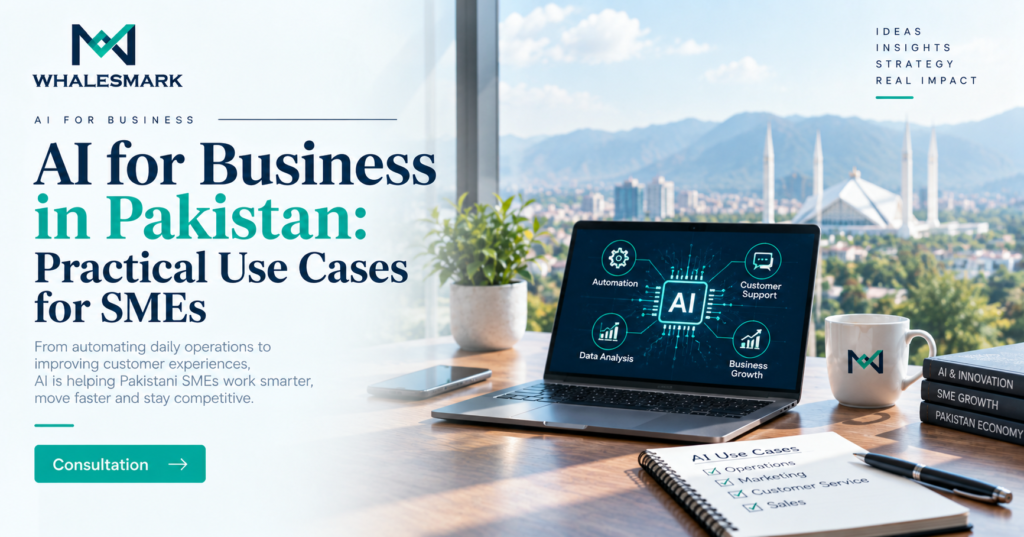
Artificial intelligence is moving from experimentation into everyday business operations. Pakistani companies no longer need to treat AI as something reserved for large technology firms. SMEs can now apply AI to customer communication, finance, sales, operations, reporting and internal workflows without building an entire technology department.
For AI for business Pakistan, the important question is not whether a company should use AI everywhere. The better question is where AI can solve an expensive, repetitive or time-consuming business problem.
Pakistan has a particularly large SME sector. The State Bank of Pakistan estimates that around 5 million SMEs operate in the country, employing about 80% of the non-agricultural workforce and contributing around 40% of GDP.
At the same time, Pakistan has moved toward a formal national AI strategy. The government approved its National Artificial Intelligence Policy in July 2025, while the policy sets targets for AI skills, research, adoption and ecosystem development.
For Pakistani SMEs, this creates an opportunity to move from AI experimentation toward practical implementation.
Table of Contents
Why AI for SMEs Pakistan Is Becoming a Business Issue
Many SMEs still depend heavily on manual processes.
Employees copy information between spreadsheets, answer repetitive customer questions, prepare reports manually, review documents, follow up with leads and spend hours searching through internal information.
These activities may not look like major problems individually. Together, however, they can consume significant employee time.
AI for SMEs Pakistan can address some of these bottlenecks by adding intelligent automation to existing workflows.
The objective does not have to involve replacing employees. In many cases, the stronger approach involves giving employees tools that reduce repetitive work and allow them to focus on decisions, customer relationships and tasks that require human judgment.

1. AI Customer Support for Faster Responses
Customer service represents one of the most accessible applications of artificial intelligence Pakistan business can adopt.
An SME can use AI to answer frequently asked questions, provide product information, classify inquiries and route complex requests to the appropriate employee.
For example, a distributor could use an AI assistant to answer questions about product availability, delivery schedules, payment methods and order procedures.
A professional implementation should connect the assistant to approved company information rather than allow it to invent answers.
This makes AI for business Pakistan particularly useful for companies that receive large numbers of repetitive inquiries through websites, WhatsApp or other digital channels.
The human employee still handles complaints, negotiations and sensitive cases. AI handles the repetitive first layer.
2. Automating Repetitive Administrative Work
One of the strongest applications of AI automation Pakistan involves repetitive administrative processes.
Consider invoice processing.
An employee may receive an invoice, read the information, enter data into an accounting or ERP system, check the supplier record and route the document for approval.
AI can assist with extracting information from documents, classifying transactions and flagging unusual entries.
The same concept can apply to purchase orders, customer forms, expense claims, delivery documents and internal reports.
The value of AI automation Pakistan comes from removing unnecessary manual steps rather than simply adding an AI tool to an existing process.
Before automation, the company should map the workflow and identify exactly where employees spend time.
3. Sales Lead Qualification
Sales teams often receive more leads than they can immediately evaluate.
AI for SMEs Pakistan can help classify leads according to predefined criteria such as industry, company size, location, previous interactions or product interest.
An AI system can summarise customer conversations, identify buying signals and prioritise leads for sales representatives.
The sales team still makes the final decision.
AI simply helps representatives focus their time on opportunities that deserve attention.
This application becomes particularly valuable when an SME manages leads through multiple channels and struggles to maintain consistent follow-up.
4. Financial Reporting and Management Insight
Finance teams can use artificial intelligence Pakistan business solutions to support reporting and analysis.
An AI-enabled analytics system can help managers identify unusual expenses, summarise financial trends, compare actual performance with budgets and generate management questions from business data.
For example, a manager might ask:
“Why did gross margin fall this quarter?”
Instead of manually searching multiple spreadsheets, an AI-enabled analytics layer could help identify changes in product mix, pricing, purchasing costs or customer profitability.
However, SMEs should not treat AI-generated financial analysis as unquestionable.
Finance professionals should validate important calculations and investigate material decisions before acting on them.
5. Inventory and Demand Forecasting
Inventory creates a difficult balance for many Pakistani businesses.
Too much stock ties up working capital.
Too little stock can cause lost sales and customer dissatisfaction.
AI for business Pakistan can support demand forecasting by analysing historical sales, seasonality, product movement and other relevant variables.
A retailer, distributor or manufacturer could use predictive models to identify products that may require higher stock levels during specific periods.
The quality of the result depends heavily on data quality.
If product records contain inconsistent codes or historical sales data contains major gaps, sophisticated AI will not automatically solve the problem.
That is why businesses should improve their data foundation before investing heavily in predictive systems.
6. Generative AI for Internal Business Work
The growth of generative AI for business has created another practical opportunity for SMEs.
Employees can use approved AI tools to draft emails, summarise meetings, create first versions of proposals, organise research, prepare marketing concepts and convert lengthy documents into usable summaries.
The business should establish clear rules before employees start using these tools.
Confidential contracts, customer information, financial data and proprietary business information require appropriate protection.
The strongest generative AI for business strategy therefore combines productivity with governance.
AI creates the first draft or summary.
An employee reviews the result.
The company retains control over sensitive information and final decisions.
7. Management Dashboards and Decision Support
A growing SME can quickly accumulate data across accounting software, ERP systems, CRM platforms, spreadsheets and sales channels.
The problem isn’t necessarily a lack of data.
The problem is turning that data into timely management insight.
AI for SMEs Pakistan can support this process by connecting business data with dashboards, forecasting and natural-language analysis.
A manager could ask about sales trends, customer concentration, inventory movement or operational performance without manually compiling information from multiple sources.
This application directly connects AI with strategic decision-making.
It also aligns with Pakistan’s national direction. The National AI Policy identifies AI adoption, skills development, research and responsible use as important elements of building an AI-enabled economy.
AI Automation Pakistan Should Start With Processes
Businesses sometimes start with the wrong question:
“Which AI software should we purchase?”
A better starting point is:
“Which process is costing us the most time, money or management attention?”
For AI automation Pakistan, process selection should consider volume, repetition, error rates, data availability and potential business value.
A process that takes an employee 15 minutes once a month probably does not need AI.
A process that takes several employees hours every day may deserve serious automation analysis.
This approach prevents SMEs from purchasing technology simply because AI is currently popular.
What SMEs Need Before Implementing AI
Successful artificial intelligence Pakistan business projects require more than software.
Businesses need reliable data, defined processes, access controls, employee training and clear responsibility for AI-generated outputs.
Pakistan’s National AI Policy includes substantial skills-development targets, including a target to train 1 million IT graduates in AI and allied technologies by 2027.
That emphasis on skills reflects an important reality.
AI adoption requires people who understand both the technology and the business process it supports.
An SME does not necessarily need a large AI department.
It does need people who can identify use cases, evaluate outputs and manage implementation responsibly.
How to Build an AI Roadmap for an SME
A practical AI for business Pakistan roadmap can start with a small number of clearly defined projects.
First, identify repetitive or high-value processes.
Next, evaluate the quality and availability of the required data.
Then estimate the potential business benefit and implementation cost.
After that, test one controlled use case.
Measure the result.
Only then should the business decide whether to expand the solution.
This method creates evidence before large technology spending.
It also allows employees to adapt gradually instead of forcing an organisation-wide AI transformation overnight.
Where Whalesmark Can Support AI Adoption
Whalesmark Consulting works across digital transformation, data intelligence and decision analytics, business strategy, automation and AI-driven insights.
That combination matters because successful AI for SMEs Pakistan projects should connect technology with business objectives.
An SME may need AI automation, but it also needs to know why the process matters, which KPI should improve, how employees will use the system and what risks require management controls.
A business-focused approach helps connect AI investment with measurable operational and financial outcomes.
The Business Case for AI in Pakistan Is Becoming More Practical
Pakistan’s AI direction is moving beyond awareness toward implementation.
The government launched Indus AI Week 2026 to connect government, industry, academia, startups and the wider technology ecosystem around practical AI adoption and skills development.
The Ministry of IT and Telecommunication also announced a wider programme targeting 1 million non-IT professionals for AI upskilling, while describing AI as a national priority and setting a government ambition for substantial AI investment by 2030.
For businesses, these developments matter because they point toward a growing ecosystem of skills, tools and AI-enabled services.
However, adoption should remain commercially disciplined.
Not every process needs AI.
Not every AI project will generate a worthwhile return.
The objective should be to identify the areas where AI can produce measurable improvements in productivity, customer experience, decision-making or operating efficiency.
Final Thoughts
The practical opportunity for AI for business Pakistan is not about following every new AI trend.
It is about finding the right business problems.
For an SME, that might mean automating invoice processing, improving customer support, prioritising sales leads, forecasting inventory, analysing management reports or using generative AI for business to accelerate routine knowledge work.
The most successful projects will connect technology with clear processes, reliable data, trained employees and measurable outcomes.
AI automation Pakistan will create more value when companies use it selectively rather than indiscriminately.
Likewise, artificial intelligence Pakistan business adoption will become more sustainable when management treats AI as part of business transformation rather than as a standalone software purchase.
The opportunity is already here.
The next question for Pakistani SMEs is not whether AI exists.
It is where AI can create enough measurable value to justify using it.
FAQs
How can AI help SMEs in Pakistan?
AI for SMEs Pakistan can support customer service, administrative automation, sales lead qualification, financial reporting, inventory forecasting and management decision-making.
What is the best starting point for AI automation Pakistan?
Businesses should start with a repetitive, measurable process where employees spend significant time and where reliable data already exists. A small pilot usually provides a better starting point than a large organisation-wide implementation.
How can businesses use generative AI safely?
Generative AI for business should operate under clear internal rules covering confidential information, human review, access controls, accuracy checks and approved use cases.
Does every SME need a dedicated AI team?
No. Many SMEs can begin with existing employees, external specialists and targeted AI solutions. The important requirement is having people who understand the business process, data requirements and risks associated with the AI application.